Momentum versus Value
Is the smart thing always the right thing?

Sometimes in life we are faced with decisions. Doing the right thing is not always the smart thing and the other way around. They are rarely one and the same thing. After running thousands of backtests across various markets I came to the conclusion that investing is no different.
Most of the people that enter this game are generally smart and want to extrapolate the success they have in their day to day professional life into the markets. Sooner or later they are facing a drawdown in their equity and can’t understand why the markets don’t respond to their smarts and success. Something surely must be wrong with the markets. A wave of reasons comes to their mind, most of them trying to reset the emotional balance and so they start blaming other factors, the markets are rigged, the CFO was doing inside trading, the pandemic came and the list is probably endless.
Stories of very successful value investors are always showcased and we are led to believe that if we are just a tad smarter that the regular Joe we can succeed. So we start reading about fundamental investing and we calculate discounted cash flows and have opinions about the markets and companies. We can brag about all the knowledge we have over beer with our mates and look smart. Because we are smart! Then we place our bets and our undervalued hidden gems don’t get the attention of the markets as soon as we want, so we close the bets and look for another hidden gem. And repeat until broke.
This process can go on and on and will be fuelled by the odd stock that will grow after our analysis giving us the illusion of some super power. The reality is that famous value investors spend all day long reading boring financial reports and have an army of analysts covering all sectors they are interested in.
Now, what is our real bandwidth to absorb information outside of our day jobs? How many companies and sectors can we cover? Probably not that many.
Stock-picking value companies is the SMART thing to do. But you need to be uber smart and committed. You need to have a deep conversation with yourself to realise when you are biased and that’s difficult to do. Is the good news on CNBC about the company you just bet on just a manifestation of the confirmation bias? Or is it the availability bias? Maybe not any of them, but a bias for sure.
On the other side of the spectrum is the Momentum investing. Growth and Momentum have a very fine line between them these days as funds pump up Companies to irrational PE ratios, but somehow people still buy them. Tesla trading at a PE ratio of 1800 is clearly mental. Use the cash in your bank as a benchmark. If you are getting paid 0.5% yearly you have a PE ratio of 200. That makes Tesla 9 times more expensive than your cash. Well, so what?
These days all that seems to matter is what’s trending and what’s hot. Is buying what’s hot the Smart thing to do? Probably not, but it might as well be the Right thing to do. At least until people jump off the bandwagon. I am a contrarian by nature and still had to buy Tesla at some point in the past even though I still don’t get it. I know, I know, vertical integration, SpaceX, etc.
So using this approach we have built an algorithm that hacks into the madness of the crowds and allows me to see in the present. Not in the future, but what’s hot this month. I like to think this is the RIGHT thing to do, until it’s not, then I might have to get smart again. And it could be anything from stocks to ETFs to commodities.
The more I think about how many worries it takes away, as I no longer have to predict the future, or be opinionated and get into pointless arguments about it, the better I sleep at night.
The logic is based on Gary Antonacci’s Dual momentum strategy, but we added our own ingredients in it to make it a bit more practical.
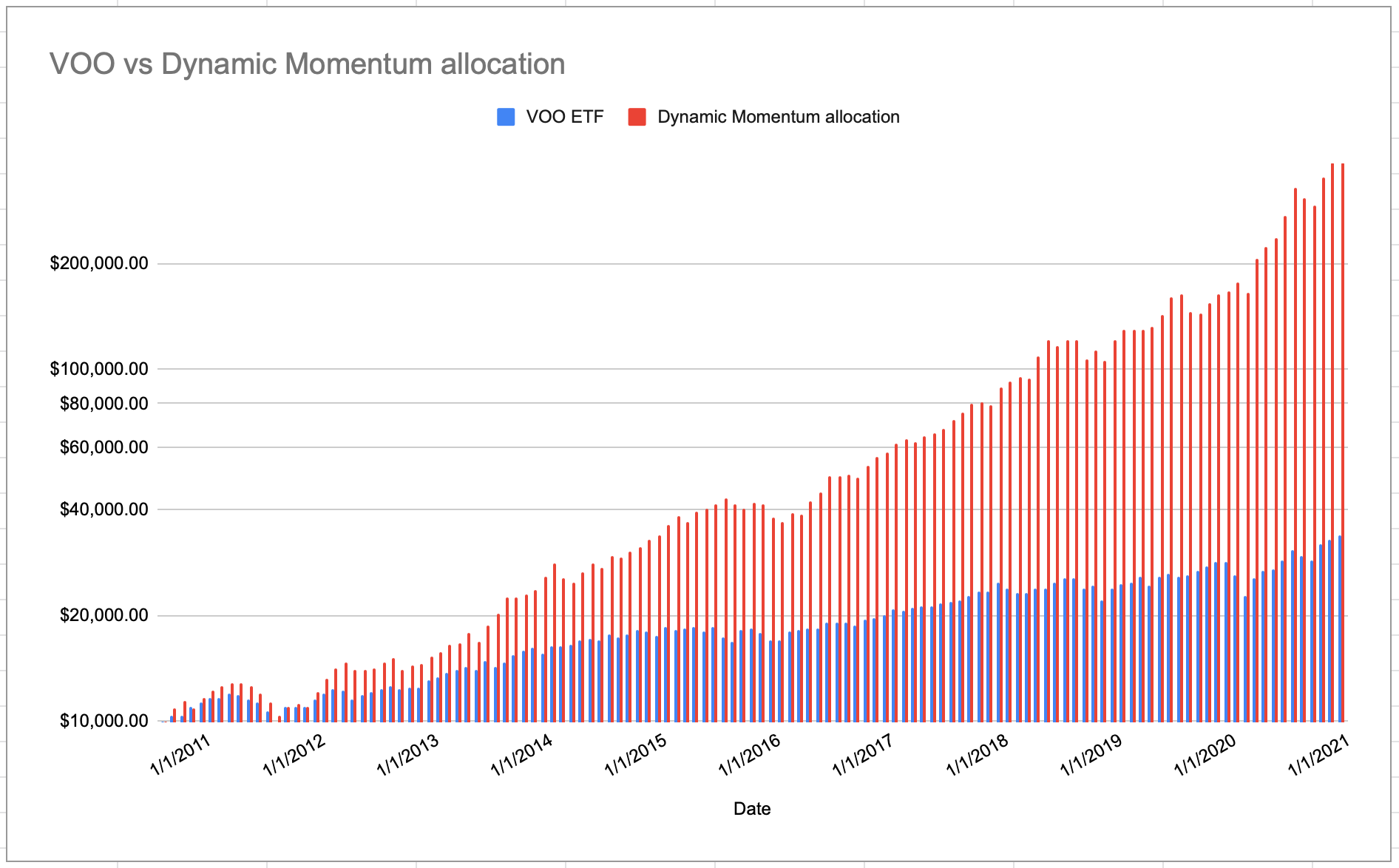
So let’s look at some historical results and compare it with the returns of the SP500 since 2010. We are going to use Vanguard S&P 500 ETF (VOO) as a proxy for the SP and we are going to run our algorithm once a month and only buy 10 stocks out of the whole index.
Note: we have not included the dividends in our calculation and we have used a virtual $10000 to begin and we have reinvested all the profits. Hence we are ignoring the dividends paid by VOO and also the ones that the selected companies would pay.
We had to plot the graph logarithmically to showcase the evolution better. The red bars are the results of the Dynamic Momentum allocation, while the blue ones are from VOO. The difference in backtest is 10 times higher approximately, as the Dynamic momentum allocation has ended with a balance of $386,217.18 while VOO with $32,919.39.
These are the more boring results:
Max drawdown 3.6%
Total down time 6%
Number of trades 641
Percent winning 77.4%
Annual return 39%
Sharpe ratio 1.55
Annualized StdDev 25.51%
R2 coefficient 0.802
Now, will this behaviour carry on in the future? I have no idea, but as long as people follow trends some sort of momentum might exist.
So what was hot in January?
I’ve plotted the correlation heat map besides the name of the instruments below.
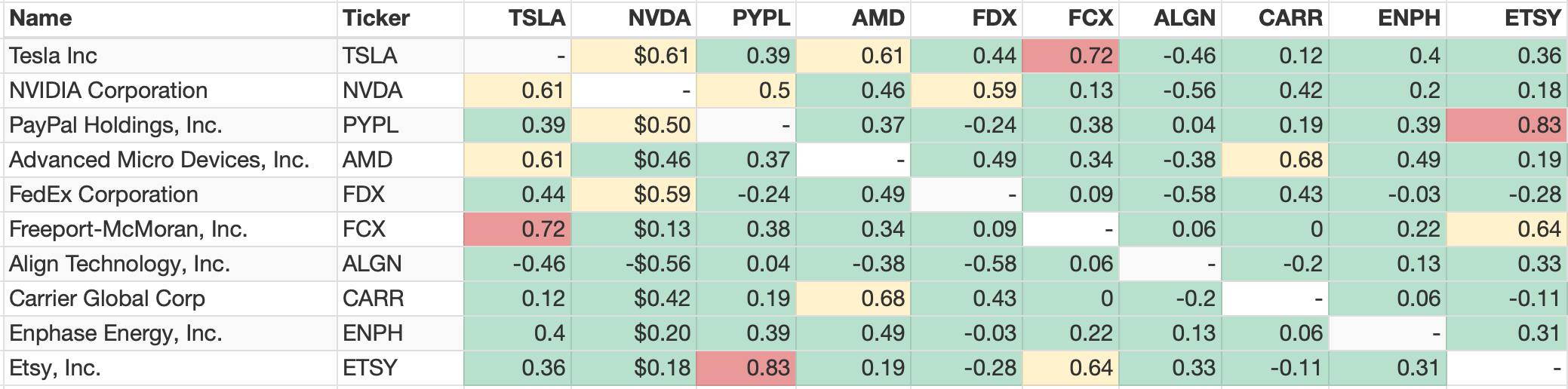
There are many reasons to actually short these stocks from a fundamental point of view. That would be smart maybe. But the markets are always right.
Disclaimer: we are not offering any financial advice and we are not promoting any of the stocks above. They are simply the result of an algorithm that we made and ran periodically. Please treat this material as entertainment or if you find it good enough, educational.
Great learning from your article!
Just a few points that I’d like to ask you to clarify:
How the Dynamic momentum algorithm selecting exactly 10 stocks out of the SP500? Is the number of stocks (ie 10) set by you or chosen by the algo?
In the logarithmic graph showing the magnitude of the most recent SP500 drop from March 2020? How would the Dynamic Momentum strategy do if started just before the crash of March 2020? I am asking this since we are in a bull market now and most markets are growing if one invests on the longer run, so most long only strategies should work. Especially if trading good quality stocks already in the select SP500 club.
Can you show us some historical examples of what kind of SP selection we had in 20016 and 2019. To have an idea if / how the hyped growth stocks are changing over time.
And lastly, is there a way to get periodic updates on the SP 500 selection? Would like to have a ‘crutch ‘ when doing the pickings , rather than using the gut.